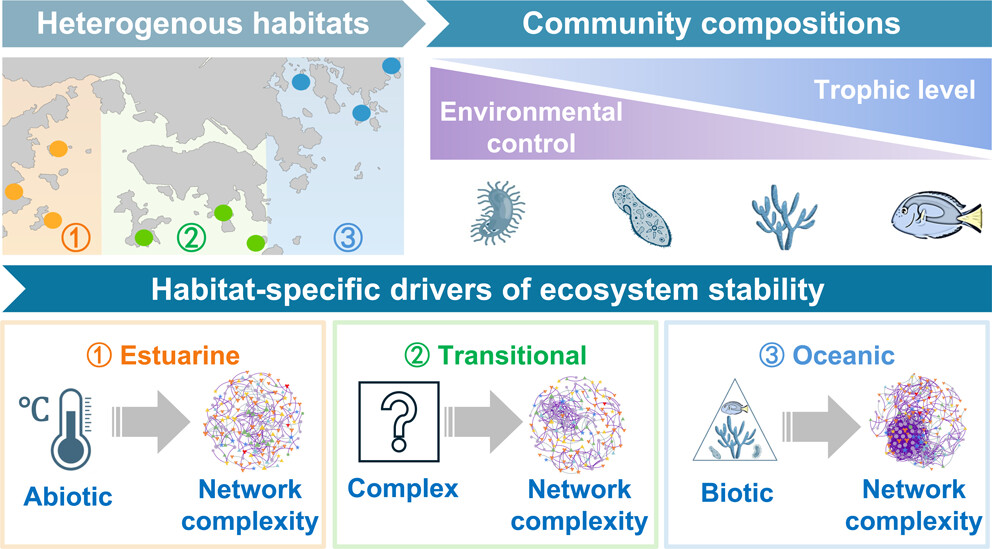
We are proud to announce the publication of our latest study, “Environmental Filtering Weakens with Trophic Level in Urban Coastal Ecosystems,” in Environmental Science & Technology. Led by Wenqian Xu, this research offers a critical look at how urbanization impacts the structure of marine food webs. Our study investigates the forces shaping community assembly across different trophic levels,from primary producers to higher-order consumers, within urbanized coastal waters. We found that while environmental conditions strongly dictate the composition of lower trophic levels (like phytoplankton), this “environmental filtering” effect significantly diminishes as you move up the food chain. Higher trophic levels appear to be less constrained by immediate water quality parameters and more influenced by biological interactions and dispersal limitations. These findings have important implications for coastal management and restoration. They suggest that improving water quality alone may not be sufficient to restore higher-order biodiversity in urban seas, highlighting the need for a holistic approach that considers the distinct ecological drivers acting at each level of the food web.